

 Jaipur
 Location: Jaipur, Rajasthan, India
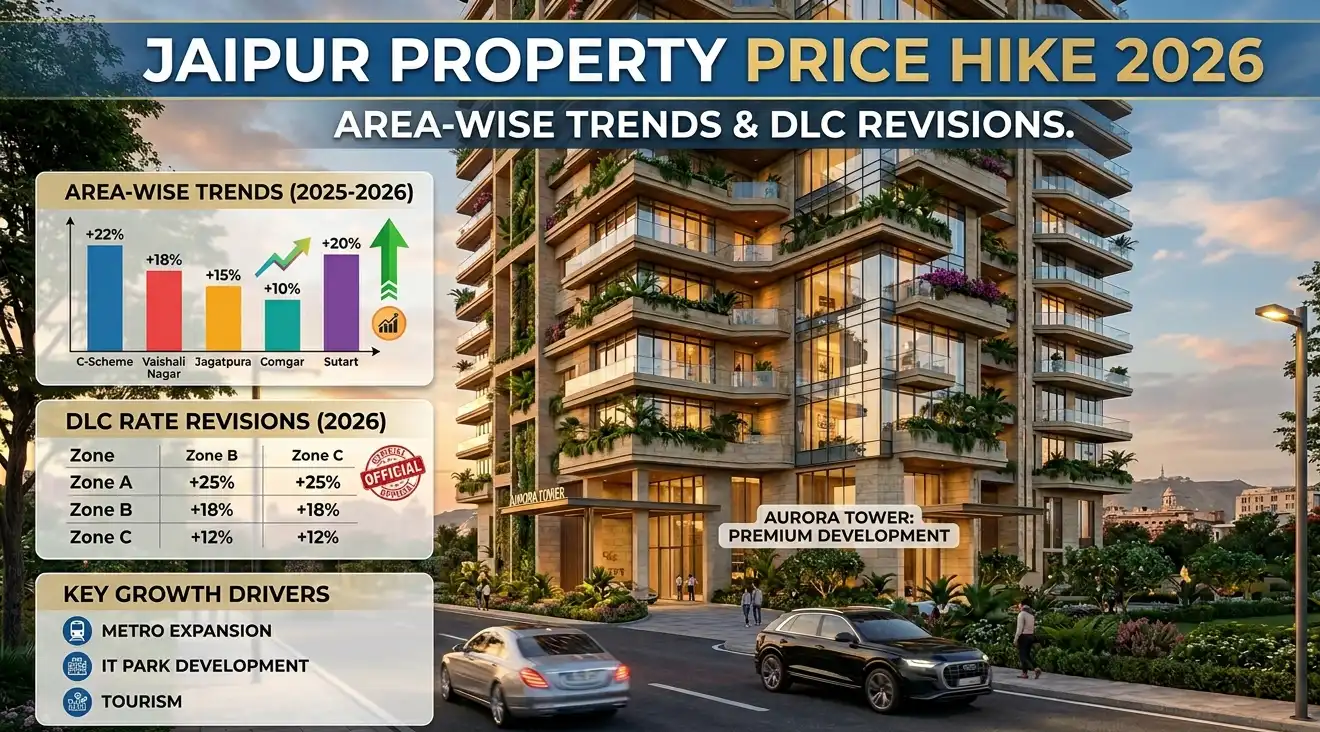
 Properties in Jaipur are experiencing a strategic price hike starting July 1, 2026. This market surge is driven by a projected 10% to 15% increase in official government DLC (circle) rates, escalating raw material costs, and an inventory crunch for premium residential sectors. Micro-markets like Jagatpura, Mansarovar Extension, and the Ajmer Road corporate corridor are witnessing the highest value appreciation.
The real estate landscape in Jaipur is on the brink of a massive structural shift. For investors, long-term builders, and prospective homebuyers, July 1, 2026, represents a crucial deadline. A convergence of state regulatory changes, infrastructure completions, and shifting buyer demographics is set to permanently alter property valuations across the Pink City.
As part of our commitment at Ikanvisit.com to deliver actionable lifestyle, travel, and relocation intelligence, our research team has analyzed the micro-market trajectories and administrative triggers pushing this mid-year property surge.
While real estate in Jaipur has been steadily compounding over the past few years, the hike taking effect on July 1st is tied directly to institutional updates:
The Rajasthan government’s registration and stamp duty department is updating the official circle rates (DLC rates). Moving into the third quarter of 2026, baseline valuations are projected to scale up by 10% to 15% in high-demand pockets. Because property registration and stamp duties are calculated based on whichever is higher—the actual transaction value or the DLC baseline—this legislative update will directly increase upfront acquisition costs. Investors can track live area-by-area circle code evaluations on the official E-Pranam Rajasthan Portal.
The outer boundaries of Jaipur are expanding rapidly, but there is an acute supply shortage for legally secure, well-planned, high-rise apartments and integrated townships inside core zones managed by the Jaipur Development Authority (JDA). Developers are currently passing on increased land acquisition costs to consumers.
Major infrastructure initiatives are reaching maturity. These include the operational deployment of the Jaipur Ring Road Phase 2, transit linkages on the Jaipur Metro Pink Line extension towards Ajmer Road, and the expansion of secondary commercial complexes along prime state highways. Updates on transport corridor timelines can be verified via the Jaipur Metro Rail Corporation (JMRC) Status Portal.
The upcoming price appreciation is highly localized. Peripheral regions that were once speculative are now transitioning into fully functional institutional and commercial zones.
| Investment Corridor | Current Avg. Price Range (Mid-2026) | Primary Infrastructure Links | Post-July Price Impact Estimate | ||
| Jagatpura & Goner Road | Plots: ₹35k - ₹40k / sq. yd. | Flats: ₹3.7k - ₹5.7k / sq. ft. | Proximity to Jaipur International Airport, Sitapura Industrial Area, and key healthcare setups. | High (Expected 12-15% jump due to heavy NRI and corporate interest) | |
| Ajmer Road Corridor | Plots: ₹28k - ₹32k / sq. yd. | Flats: ₹4.2k - ₹6.0k / sq. ft. | Mahindra World City (SEZ) corporate employment hub, direct Phase-2 Metro extensions. | Moderate-High (Driven heavily by steady commercial occupancy and high rental yield) | |
| Mansarovar Extension | Flats: ₹5.2k - ₹6.5k / sq. ft. | Saturated central Mansarovar pushing middle-income families to luxury high-rise gated societies. | High (Fueled by the acute shortage of ready-to-move-in inventory) | ||
| Tonk Road & Outer Periphery | Plots: ₹32k - ₹38k / sq. yd. | Strategic highway connectivity and intersection with outer Ring Road development nodes. | Moderate (Mainly driven by speculative land aggregation and the new DLC shift) |
With prices climbing quickly, real estate consultants warn that fear-of-missing-out (FOMO) can leave buyers vulnerable to predatory schemes in unregulated pockets. Protect your capital with this three-step verification framework:
For investors aiming to optimize capital efficiency, the pre-July window presents a narrowing window of opportunity. Aligning your capital with high-yield rental assets—specifically compact 2-BHK apartments or smart studios near the Mahindra World City SEZ or the institutional hubs of Jagatpura—offers an effective hedge against upcoming inflationary spikes.
Q1: What is the current property price trend in Jagatpura, Jaipur? A: As of mid-2026, plots in Jagatpura and Goner Road range between ₹35,000 and ₹40,000 per square yard, while premium apartments trade between ₹3,700 and ₹5,700 per square foot. These figures are projected to jump by 12-15% after the July DLC rate revisions.
Q2: How does the DLC rate impact property prices in Rajasthan? A: The District Level Committee (DLC) rate is the minimum valuation at which a property can be registered with the government. An increase in the DLC rate directly causes stamp duty and registry expenses to rise, inflating the overall transaction cost for buyers.
Q3: Is it safe to buy non-JDA approved plots in Jaipur? A: No, buying non-JDA approved plots carries high legal and financial risks, including a lack of basic civic infrastructure, resale difficulties, and potential demolition actions by the authority. Always check for explicit JDA and RERA compliance.
Disclaimer: This market report is compiled by the editorial desk of Ikanvisit.com using regional public data. Real estate investments are subject to market risks; readers must perform individual legal audits before finalizing agreements.



 Sep 10, 2026
  Jun 30, 2026
  Chat with us We reply instantly
 To add another property, remove one from your compare list.
Please log in before using this property action or opening member-only details.
 logout
 Login
Login
 My Account
 Wishlist